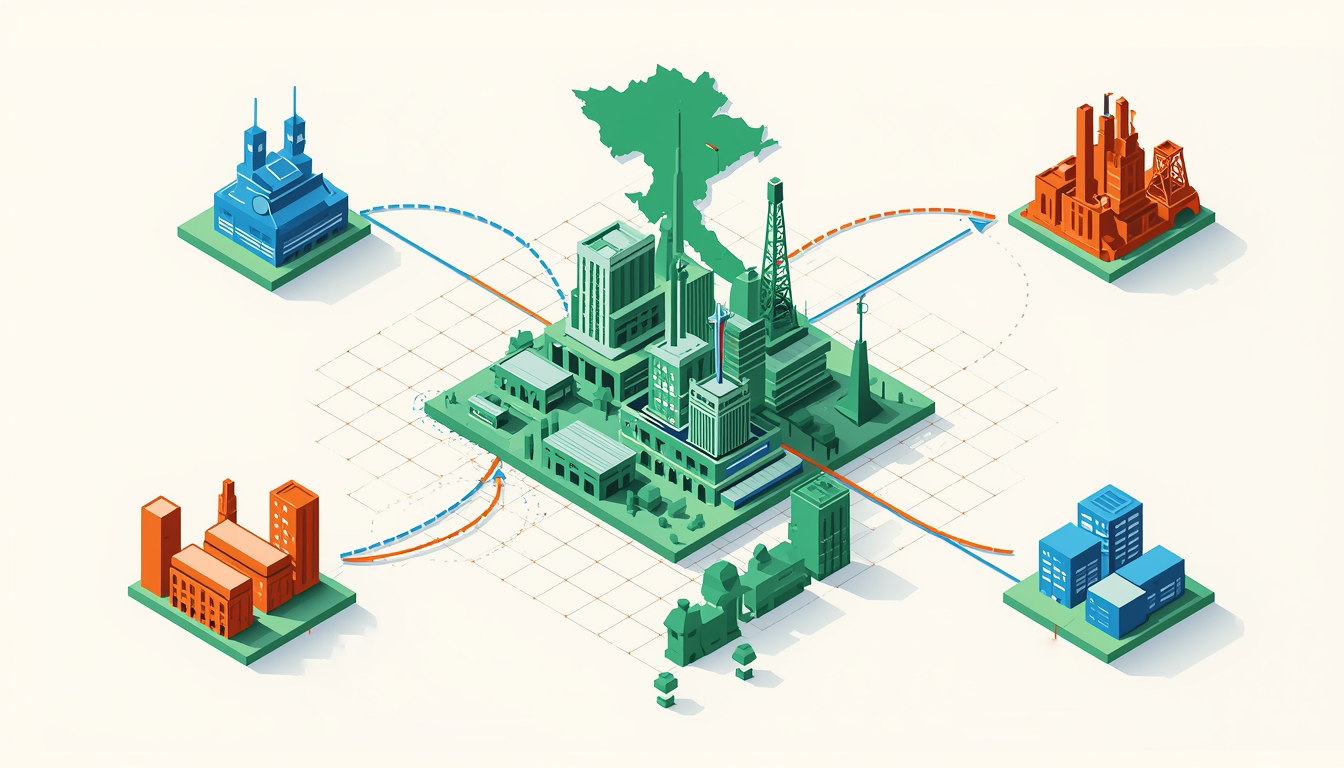
Vietnam has attracted $36B in FDI in 2024. But what does it really take to set up a successful manufacturing operation? Our team shares insights from the ground.
Something fundamental has shifted in global manufacturing over the past decade, and Vietnam sits at the center of it. A country of 100 million people that was exporting predominantly agricultural commodities twenty years ago now produces smartphones, semiconductors, precision electronics, high-end furniture, and industrial components for the world's most demanding brands. Its economy grew by 7.09% in 2024 and accelerated to 8.02% in 2025 — among the fastest rates of any economy of its size on earth.
How Vietnam Became the World's Factory Floor
Vietnam's transformation was the product of deliberate policy choices — a stable political environment that prioritized export-led growth, competitive labor costs, successive free trade agreements, and aggressive FDI attraction.
Manufacturing now accounts for 24% of GDP and captured 56.5% of all new FDI in Q1 2025. Total exports reached $405.5 billion in 2024. Foreign-invested enterprises accounted for nearly three-quarters of total exports in 2023, reaching 90% in strategic categories including phones, computers, and machinery.
Samsung has committed more than $20 billion to the country, operating complexes that account for nearly half of Samsung's global smartphone output. Intel's $1.5 billion chip facility, Amkor's $1.6 billion chip packaging facility, and LG's major manufacturing operations further cement Vietnam's position.
The European Angle: EVFTA
For European manufacturers, Vietnam holds a structural advantage: the EU-Vietnam Free Trade Agreement (EVFTA), one of the most comprehensive trade agreements the EU has concluded with a developing economy.
European goods entering Vietnam enjoy 0% import tariffs. Vietnamese goods exported to the EU benefit from near-zero tariffs. As the only Southeast Asian nation with a full FTA with the EU, Vietnam holds a competitive edge over Thailand, Indonesia, Malaysia, and the Philippines.
EU investors had poured €28 billion into approximately 2,450 projects by 2023. LEGO opened a $1 billion factory in Binh Duong province in April 2025 — its most environmentally advanced facility anywhere — reflecting a "in region for region" manufacturing model increasingly common among European companies.
The Challenges: What Experienced Investors Know
Power and Energy Infrastructure. Power outages in summer 2023 forced companies including Foxconn to cut energy consumption by approximately 30%. For energy-intensive manufacturing, this represents a material operational risk.
The Skills Gap. Between 45% and 70% of the workforce lacks formal technical training, and only 11% of workers meet "highly skilled" standards. The country faces a projected shortfall of 2.1 million qualified industrial workers by 2030.
Bureaucracy. In a 2024 survey, 69% of foreign-invested enterprises cited inconsistent laws and enforcement as a primary concern, and 49% flagged inefficient bureaucracy. The introduction of global minimum tax rules in 2024 created particular disruption.
The China Dependency Trap. For electronics manufacturing, approximately 40% of imported components still originate from China. Manufacturers who move final assembly to Vietnam often find their supply chain still runs through China at the component level. Moving final assembly while remaining 80% dependent on Chinese components does not constitute genuine supply chain diversification.
How to Approach Vietnam Strategically
European companies that succeed in Vietnam share operating principles: they choose industrial zones carefully (established zones near Hanoi, HCMC, and Binh Duong offer superior infrastructure); they invest in workforce development, not just the wage bill; they engage local legal and regulatory expertise from day one; and they think in multi-year timeframes.
Vietnam is not going to replace China as a manufacturing base. But for European manufacturers looking to build a more resilient, diversified supply chain, Vietnam offers genuine manufacturing capability, improving infrastructure, a favorable trade agreement, and a government that has consistently prioritized industrial development over three decades.
Tags
Sources
Vietnam Briefing — Vietnam Economy 2024-2025; EuroCham — Four Years of the EVFTA; LEGO Group press release; Supply Chain Dive; US State Department 2024 Investment Climate Statement Vietnam.